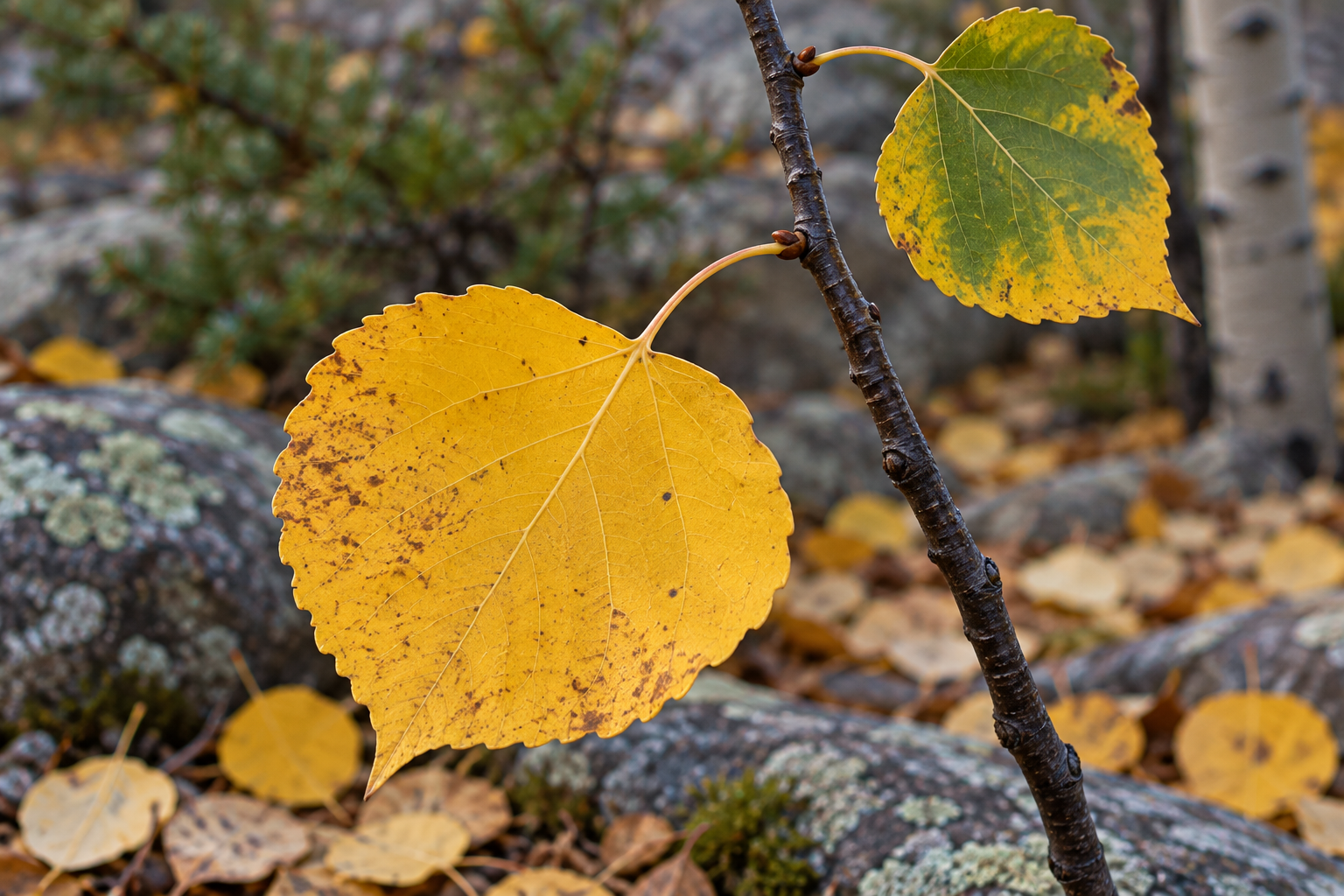
A yellow leaf can hold to its twig through several cold mornings. Another, still mottled with green, comes down in a mild breeze. Both sights make more sense once we separate two events that autumn often lets us see together. Senescence is the leaf's orderly loss of its working parts, including the green pigment and much of the machinery of photosynthesis. Abscission is the later separation of the leaf from the tree. Color is evidence of change inside the blade; falling requires a change at its attachment.
The question “What starts a leaf falling?” therefore has two clocks in it. What tells a tree to begin winding down the leaf? And what finally lets the leaf go? The answer to the first depends on species, season and condition. The answer to the second happens in a narrow region of cells near the leaf's base. Neither can be reduced to the first frost or the gust that happens to carry the leaf away.
The season reaches the leaf
Day length is an appealing signal because it changes predictably from year to year. In a seven-year experiment beginning in the 1940s, Charles Olmsted grew potted sugar maple seedlings from two Wisconsin seed trees under natural and controlled light schedules. Leaves that had opened any time from February to August were mostly shed in October and November when the seedlings received the naturally shortening days. Holding seedlings at fixed lengths of daylight delayed loss of green and leaf fall; moving some from long to short days hastened both. Olmsted concluded that declining autumn day length was important for that population. In every treatment, the leaves lost green before they detached. His original experiment gives us an unusually clear link between a seasonal cue and the order of events, though potted seedlings from two parent trees cannot stand for every mature tree in a forest.
European aspen seemed at first to offer an even neater clock. Researchers followed a free-growing tree in Sweden through autumn 2003, measuring pigments, nutrients, photosynthesis and the condition of cells. Its coordinated senescence began on September 11. The team inferred that photoperiod—the daily span of light—had initiated it, because the start was so regular and other obvious weather signals did not fit. That cellular timetable remains valuable for showing what happens after the start, even though its proposed trigger was an inference from one tree.
A broader 2009 aspen study followed trees outdoors and clones in controlled settings. It found that growth arrest and bud set came before a tree was ready to senesce, and that cooler conditions could speed chlorophyll loss after senescence began. The authors proposed a later day-length signal to explain the onset. In other words, even within their model, the tree first had to reach a receptive state; a short day by itself was not an instant command to drop a leaf.
Then the same research community tested the day-length idea more directly. In two Swedish common gardens, one north of the other, researchers followed 116 aspen genotypes. Bud set broadly behaved like a photoperiod response. The onset of leaf senescence did not: the same genotypes began at different day lengths in the two gardens. The authors concluded that day length itself was not the immediate trigger for senescence in these aspens, although the evidence still pointed toward a light-related signal not yet identified. Their common-garden study did not erase the earlier observations. It changed what those observations can prove.
This is why “the days get shorter” is useful as a description of autumn, but too tidy as a universal explanation for a leaf's departure. Sugar maple seedlings responded strongly to manipulated light schedules. The aspen gardens separated the date of senescence from a simple critical day length. A tree's genetic background, its prior growth and its surroundings all belong in the question. Temperature can alter the pace once the process is under way. A shade-stressed or drought-stressed leaf may also be shed by a route that does not follow the ordinary, coordinated autumn display.
What the leaf does before it leaves
Once senescence begins, the blade is not merely fading. Chlorophyll and parts of the photosynthetic apparatus are dismantled. Other pigments may become more visible or be made anew, so color can change while the leaf is still chemically active. In the closely watched Swedish aspen, breakdown of leaf constituents took about 18 days. The researchers estimated that roughly four-fifths of the nitrogen and phosphorus in the measured leaves had been moved elsewhere by the end of that phase. Some cells remained active for more than a week, until the last leaves fell. Those numbers describe that tree and season; they do not set a timetable or recovery percentage for a street maple, a beech or a droughted sapling. The team's measurements make the important point more modestly: a changing leaf can still be doing work for the tree.
The loss of green is thus a poor stopwatch for the moment of release. Olmsted's sugar maples always lost green first, yet the delay between color and detachment varied. A leaf may finish much of its internal housekeeping and remain attached. Wind can expose that fact. It can pull away a leaf whose connection has already weakened, while a nearby leaf holds on because its connection is still sound.
The narrow place where a leaf lets go
The final connection is prepared in an abscission zone, a small band of cells at the leaf's attachment. Cells there must loosen their grip on one another. In a microscopy study of citrus leaf tissue, researchers treated detached leaf pieces with ethylene and examined their separation surfaces. After 24 hours, part of the zone separated more readily; after 48 hours, the blade fell at a slight touch. The images pointed to changes in the pectin-rich middle layer that helps neighboring cell walls adhere. The citrus experiment reveals a physical mechanism, though citrus explants under applied ethylene are not a natural autumn canopy.
A Populus experiment adds another caution against a one-switch story. Researchers darkened individual leaves to induce abscission and tracked two plant hormones, auxin and ethylene. Adding auxin delayed separation. Trees unable to respond normally to ethylene still formed an abscission zone, but their leaves separated late or sometimes not at all; genes for wall-modifying enzymes depended on ethylene signaling. The researchers also saw a localized auxin response before the zone formed, suggesting auxin helps place the seam as well as regulate when it opens. These are controlled darkening experiments. They tell us how a leaf can be made to detach, not that natural autumn follows precisely the same hormone schedule.
The seam makes the last moment look sudden. By the time a leaf spins away, its blade may have spent days withdrawing useful material and its attachment may have spent more time becoming a place where cells can part. The breeze supplies motion, but the tree has made departure possible. Which seasonal cue began that preparation remains a question to ask of a particular tree, in a particular place, with senescence and detachment kept on their separate clocks.
A thought worth keeping?