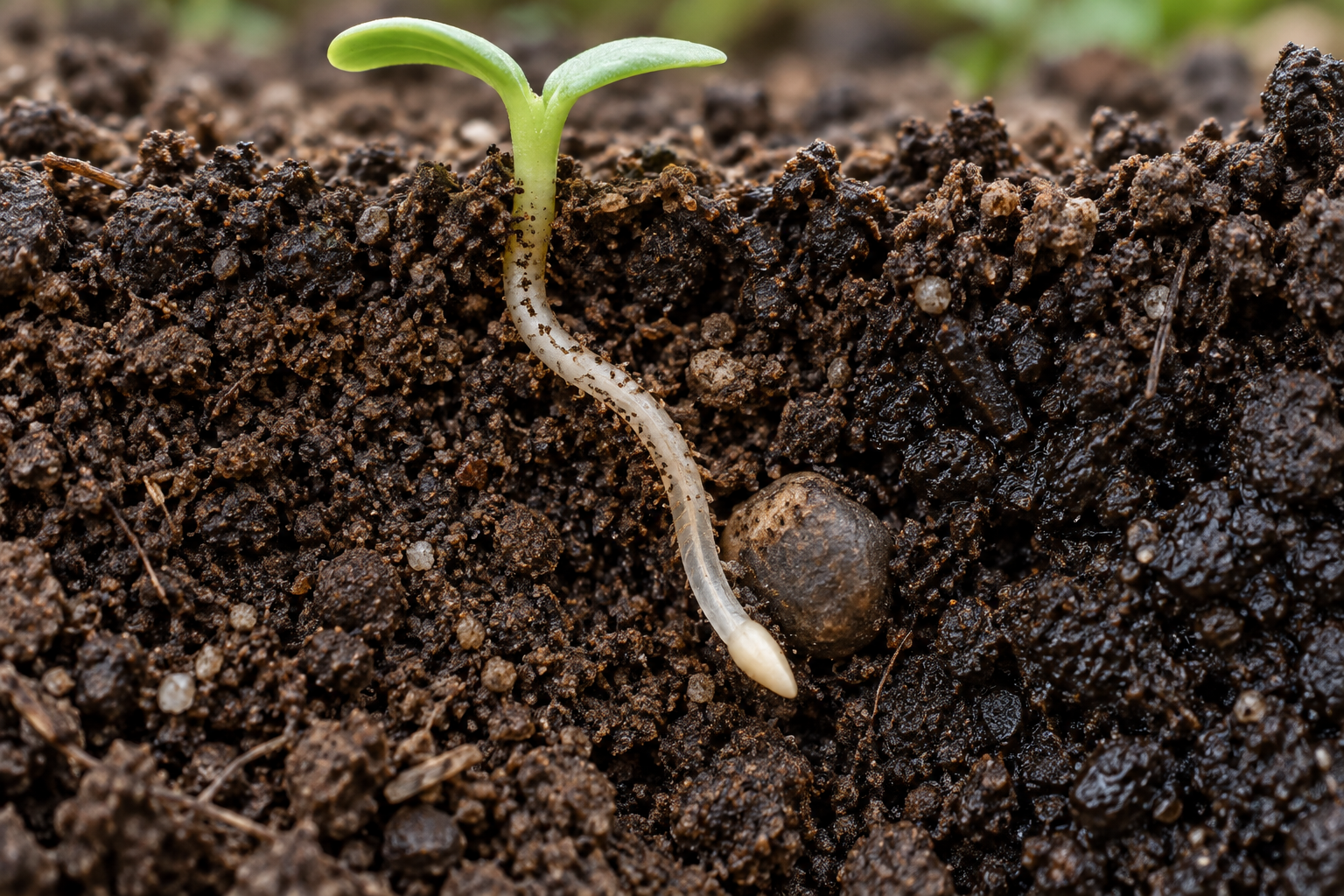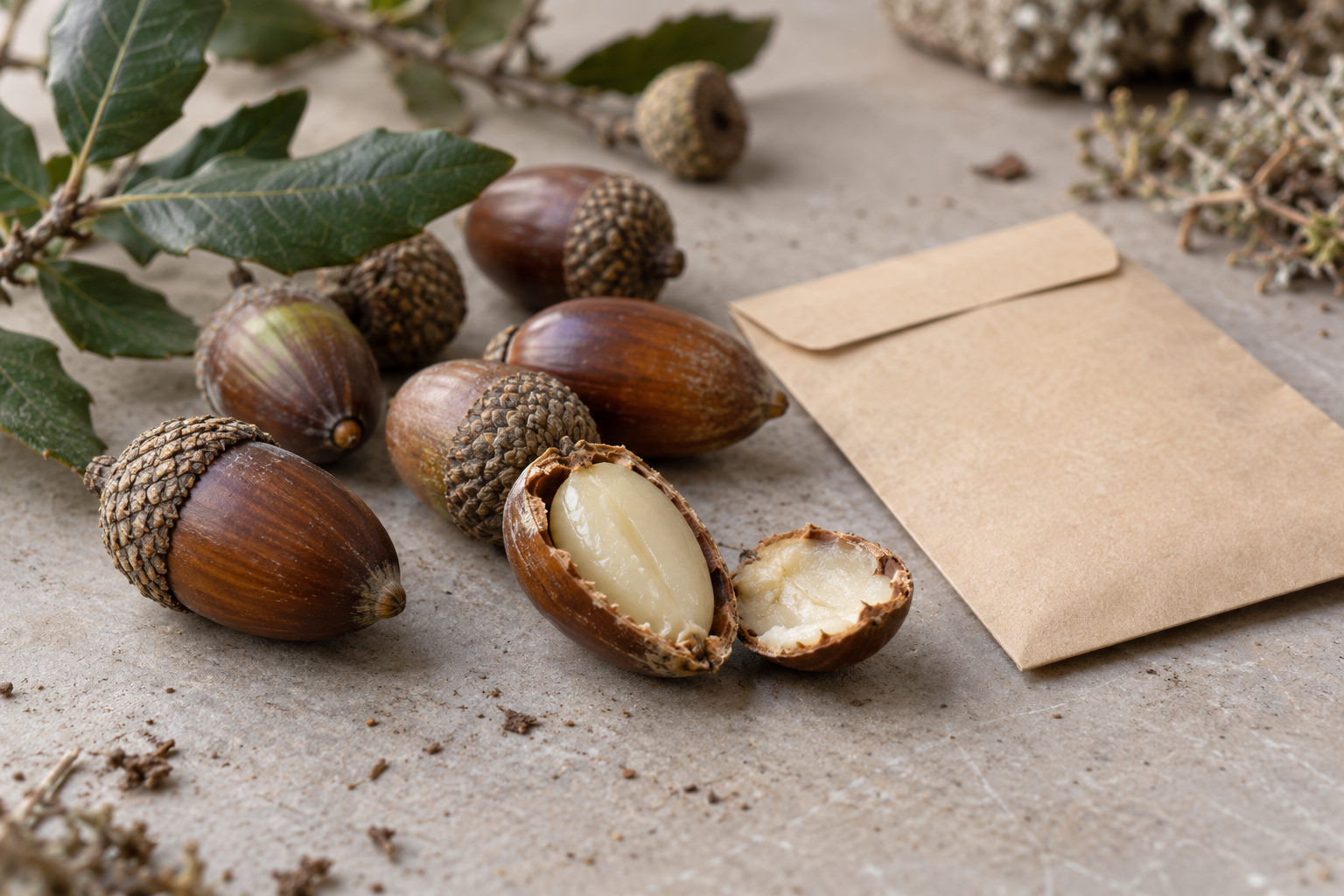
An acorn looks like an excellent thing to save for later. It is compact, sealed in a shell and already carries what an oak needs to begin growing. Yet the routine that makes a seed bank work for many plants—dry the seeds, seal them, and put them in a freezer—can kill an acorn before it enters storage. The problem begins with the water inside it.
At Kew's Millennium Seed Bank, the standard route for suitable wild seeds is exacting. Collections are dried until they equilibrate with air at roughly 15% relative humidity, sealed in airtight containers, then held near −20°C. The standards also call for initial viability tests and later monitoring. A jar in a freezer is useful only if its contents can still germinate when they are needed. Kew specifies that this routine is for orthodox seeds: seeds able to survive substantial drying.
The dry step is not just preparation for the cold step. It makes the cold step possible. A Kew technical sheet on seed drying explains that low moisture lets orthodox seeds tolerate freezing, slows deterioration and delays germination. Remove enough water, and the seed can wait. A seed that must remain wet faces a different bargain: drying can injure it, while freezing its remaining water can damage living tissue. The same freezer temperature cannot be prescribed for both.
The acorn's narrow margin
Seeds that cannot withstand deep drying are called recalcitrant. The term describes storage behavior, not a seed that resists being planted. Oaks and horse chestnuts are familiar temperate examples; Kew's account of the conservation problem also names sweet chestnut. The category contains variation: different species, and sometimes different populations, tolerate different degrees of water loss and cold. Their common difficulty is that the standard dry, −20°C bank is unsuitable.
A holm oak study shows how little room one acorn has. Researchers collected mature Quercus ilex acorns near Montpellier and measured their germination as they dried. The fresh seeds held about 40.7% water by weight. Germination fell to half its initial level when water content reached about 30.6%. In the same 2013 study, researchers sampled acorns after winter in 42 French woodlands and found that their water content strongly tracked whether they could germinate and develop normal seedlings. The laboratory threshold is for this species and these measurements; it is not a universal acorn setting.
That field result gives the storage problem an ecological setting. An acorn lying on the forest floor does not get a seed bank's controlled conditions. In the surveyed woodlands, rainfall, maximum winter temperature, shade and ground cover influenced its water status. A dry spell between autumn shedding and spring establishment could therefore cost the seed its chance to grow. The trait that makes holm oak acorns awkward to bank is consequential outside the bank as well. The study does not show that every failed acorn died of drying—animals, fungi and other conditions also matter—but the relationship between water content and viability was unusually strong.
Keeping acorns moist and merely turning down the thermostat can buy time, not indefinite storage. In a 2022 experiment on pedunculate oak, researchers held treated acorns for six months at −3°C or −7°C. Both groups lost quality compared with unstored seeds, and the −7°C group produced fewer seedlings. The authors found changes in metabolites consistent with freezing stress, although they presented that mechanism as a hypothesis. This was one seed lot under defined conditions; it does not set a single safe temperature for every oak. It does show why “colder” need not mean “better” when a living seed still contains substantial water.
There is a practical difference between a few months of nursery storage and a conservation collection meant to span generations. A forester may need sound acorns until the next sowing season. A gene bank must keep a plant's genetic material viable far longer, and ideally document which population it represents. Short, moist storage can serve the first purpose for some species. It cannot simply be extended into the second by lowering a freezer dial.
Saving a smaller living part
The apparent contradiction in seed conservation is that some of these species can be preserved at temperatures far below a conventional freezer. The material changes first. Rather than freeze a whole wet acorn, researchers remove the embryonic axis—the small part that can form root and shoot—adjust its water content and cooling conditions, then store it in liquid nitrogen. The balance is delicate: too much water can form damaging ice; too much drying can kill tissue before it reaches the cold. Kew's 2018 explanation of cryopreservation describes the embryo route as a potential solution, while researchers continue to work out which preparation and recovery steps suit particular species.
The result must be judged after thawing. An axis that remains alive but cannot produce both a root and a shoot is not yet a replacement tree. In an experiment comparing embryonic axes from four oak species, shoot-forming tissue was often more sensitive than root-forming tissue to removal, drying and deep freezing. Some axes survived the cold yet developed abnormally. That finding explains why a survival percentage alone may flatter a storage method: recovery of a whole plant is the demanding test.
There is also evidence that carefully prepared tissue can last. Ballesteros and Pence's 2019 study tested axes of black walnut and two horse chestnuts after 11 to 23 years in liquid nitrogen. Viability of black walnut and common horse chestnut axes had not declined significantly after 23 years; that of Ohio buckeye axes had fallen from 80% when fresh to 33%. The long interval is encouraging, and the difference among species is the warning beside it. These were preserved pieces of embryos, revived in culture under research conditions, not jars of whole seeds ready for direct sowing.
The acorn and the freezer are therefore a poor match only if the acorn must go in whole, wet and unprepared. A useful conservation plan begins earlier, with a test of how the species handles drying and cold, and it ends later, with a test of whether stored material can make a healthy plant. Between those tests lie the small, species-specific decisions that turn a frozen sample into a living future oak.
A thought worth keeping?