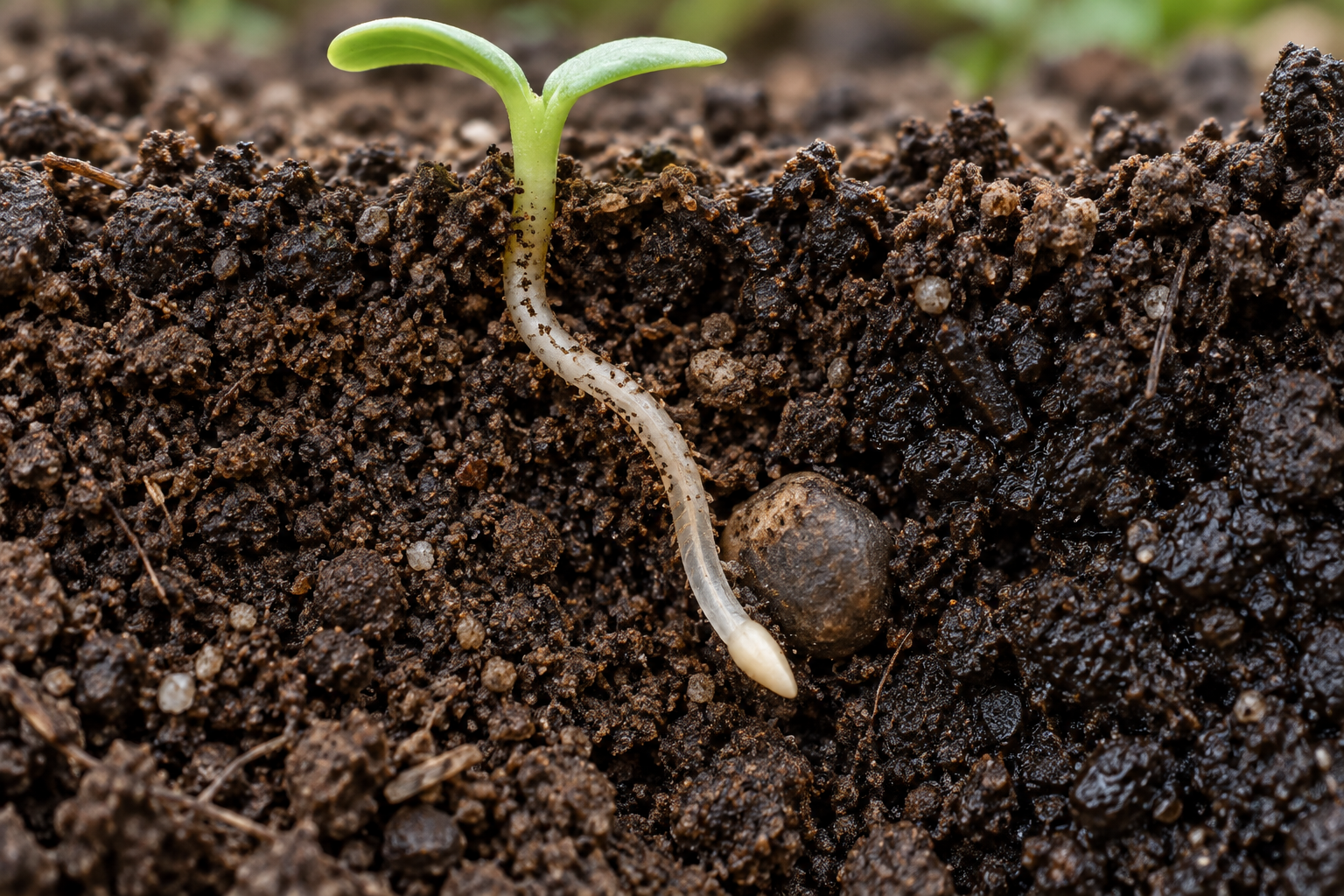
A young root enters soil without a view of the space ahead. Its growing end meets grains, pores, water held between them and the steady pull of gravity. When its path curves around a barrier or toward a wetter patch, the change can look purposeful. The useful question is more exact: which cells register a difference, and how does that difference become a bend?
The root tip is a small region with different jobs crowded together. A cap covers its growing point. Behind it, cells divide; farther back, newly made cells lengthen and push the tip onward. A turn happens when cells on one side lengthen differently from cells on the other. That simple geometry links several kinds of sensing to one visible result, but the signals do not all begin in the same place. Work on Arabidopsis thaliana, a small experimental plant, has been especially useful because researchers can remove particular cells or alter their responses and see which kind of turn remains.
A downward reference
For gravity, the central cells of the root cap have a well-tested role. They contain dense, starch-filled bodies called amyloplasts, which shift position when the root is reoriented. In a 1998 laser-ablation experiment, Elison Blancaflor, Jeremiah Fasano and Simon Gilroy removed selected cap cells from young Arabidopsis roots. Removing inner columella cells greatly weakened the downward-curving response without simply stopping root growth. Removing peripheral cap cells had much less effect. The inner cells whose loss mattered most also showed the fastest amyloplast settling. That combination supports the idea that the cap's columella supplies a gravity reference; it does not mean every cap cell performs the same task.
Sensing down is not identical to growing down. The first event is a physical change in cells near the tip. The visible curve forms behind them, where unequal expansion can redirect the advancing root. This separation matters because a root that fails to bend could have lost its gravity detector, its signal path or the ability of its growing cells to expand unequally. The ablation study checked growth rate while measuring curvature for precisely that reason. A flat line on a time-lapse film is evidence of a failed response, not by itself a map of where the failure began.
Water does not use the same address
Water offered a surprising comparison. A root can bend in response to a difference in water potential, the measure of how readily water can move from one place to another. It is tempting to put this detector in the cap as well. Yet Daniela Dietrich and colleagues' 2017 experiments found that Arabidopsis roots still bent toward a higher-water-potential side after laser removal of the cap and much of the growing tip. The same treatment impaired the gravity response. The team also removed the distal tip by another method and tested roots without a moisture gradient, reducing the chance that injury alone had produced a false turn.
Their tissue-specific experiments shifted attention to the cortex in the elongation zone, a layer just inside the root's outer surface. Restoring the hydrotropism-related protein MIZ1 or an abscisic-acid signalling component in that tissue restored water-directed bending in the relevant mutant backgrounds. Disrupting differential growth specifically in the cortex blocked that bending while leaving gravitropic responses intact. In these experiments, the zone that expands to make the curve could also register the water-potential difference. The authors did not claim that an intact cap never contributes to water responses; they showed that this cap was not required for the response under their tested conditions.
That finding changes the mental picture. A root need not send every message from a single point at its very end to a separate motor farther back. Gravity and moisture can be routed through different tissues in the last stretch of the root, then expressed through changes in cell length. A bend is the integrated result of growth, not proof of one all-purpose “root sense.”
The water result is not confined to an agar plate, though soil adds complications. In a 2013 soil-chamber study, Satoru Iwata and colleagues compared ordinary Arabidopsis plants with plants lacking a functional MIZ1 response and plants overexpressing it. Under an imposed soil-moisture gradient, ordinary roots developed more on the wetter side; the MIZ1 mutant did not show the same pattern, and the overexpressing plants showed a stronger one. The authors also measured greater shoot growth and survival under their water-limited treatment in the overexpressing group. Those are results from particular Arabidopsis genotypes and a constructed gradient. They show that water-directed growth can matter in soil, not that every seedling in every field can locate a hidden reservoir or escape drought by turning toward it.
A hard edge is another signal
A pebble or dense layer presents a different problem. It resists the tip's advance. In a 2009 Arabidopsis study, Gabriele Monshausen and colleagues touched cells, bent roots and placed barriers in their path while following fluorescent markers. Mechanical stimulation produced rapid, short-lived changes in calcium inside cells, accompanied by changes in acidity and reactive oxygen species outside them. The signals differed with the kind of stimulus. A calcium pulse is not itself a decision to turn left; it is measurable evidence that a mechanical event has been registered and passed into a cellular response.
The growth consequence takes longer. Amy Jacobsen and colleagues' 2021 barrier experiments followed Arabidopsis roots meeting a horizontal plastic edge on a gel plate. The roots bent to grow along it, then bent downward again. The researchers measured unequal cell elongation across the growing zone and found changes involving reactive oxygen, ethylene and auxin signalling. In their apparatus the obstacle response unfolded over hours, while the first molecular and growth changes began earlier. A stone in a field has neither the tidy face nor the chemistry of a plastic strip; the experiment isolates a response to impedance rather than reproducing all of soil. It also shows why touch and gravity are hard to separate in a finished root path: after contact, the root still has its downward reference.
When signals disagree
The tip's direction is therefore not set by a single command. Salt provides an unusually clear case in which cues conflict. In experiments reported by Carlos Galván-Ampudia and colleagues, roots of Arabidopsis, tomato and sorghum seedlings grew away from a higher-salt region even when that took them off the gravity axis. The researchers linked the turn to redistribution of the growth hormone auxin in the tip and to changes in a transporter called PIN2 on the salt-facing side. This is a response to the salt gradients and species they tested. It should not be converted into a claim that all roots avoid every salty patch, or that a root can sample the whole soil volume before choosing a route.
These experiments also reveal why the word sense needs care. A root has no eyes or intention in this account. It has cells whose contents shift under gravity, tissues whose growth depends on a water-potential difference, and rapid signals after physical contact. Salt can alter the placement of molecules that guide growth. Each result was made visible by a particular manipulation and measurement; none gives a complete forecast for a living root in irregular soil, where water, resistance, air and chemistry change together.
What the root tip can do is more interesting than a miniature imitation of an animal's senses. It can keep growing while its near end continually changes the rate and direction of that growth. The cap, the cortex and the elongating cells do not need to agree in advance about a destination. Their responses leave a narrow new path through the soil, one cell-length difference at a time.
A thought worth keeping?