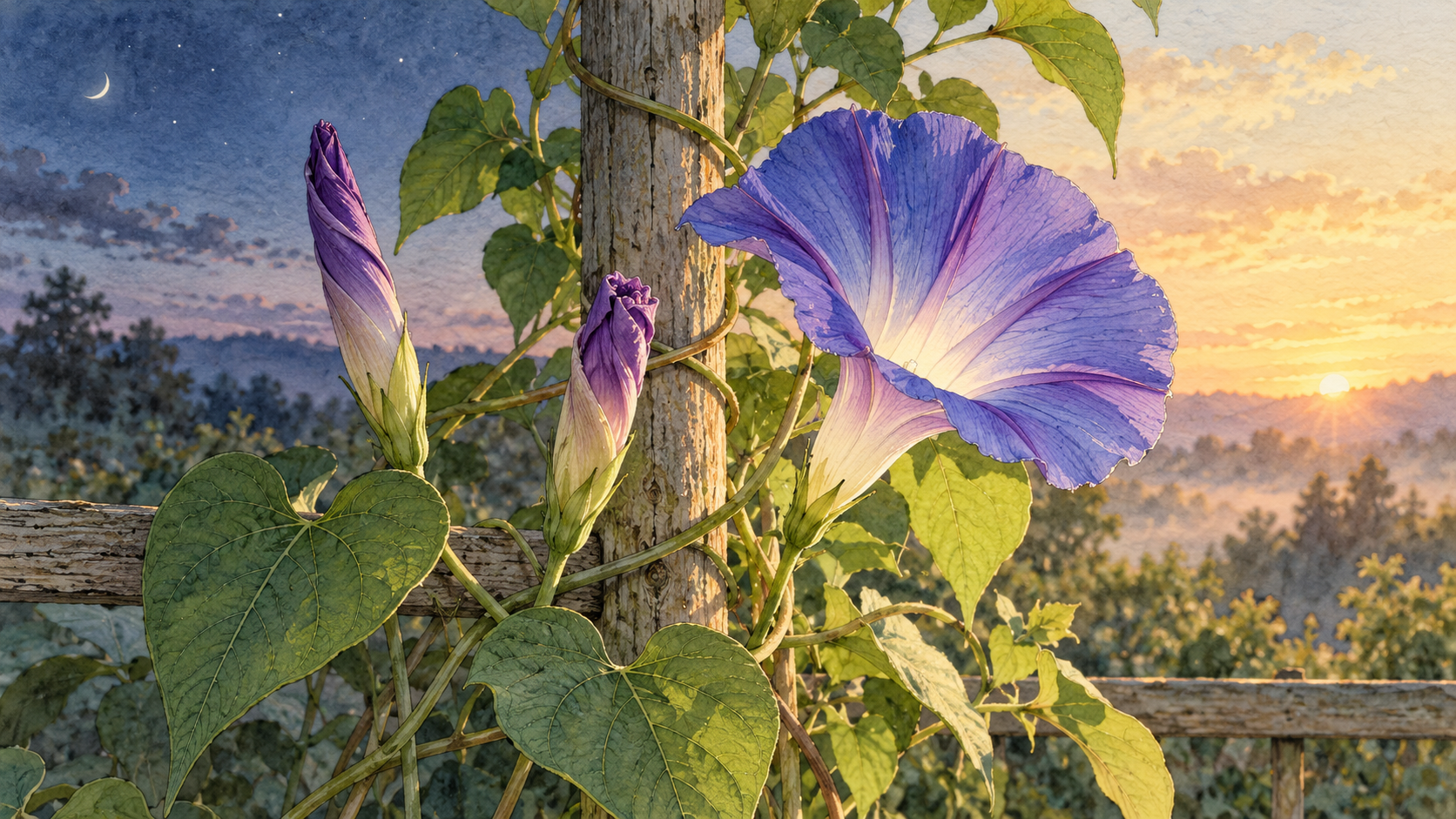
A morning glory may open close to dawn, but dawn is not a finger pressing a switch. The bud has spent the night growing toward readiness. Its petals respond to the light and temperature they meet, and the plant has an internal rhythm that helps place the movement within a day. Change one condition and the hour can move. Change the species and the whole arrangement may change with it.
It helps to separate three events that everyday language calls flowering. A plant first makes a flower bud. A mature bud then opens, exposing its reproductive parts. Some open flowers later close and reopen, while others have a single opening before they fade. The hour of opening is a question about that last movement, not about the season when the plant first blooms. A mature bud can open on a different schedule when its light and temperature conditions change.
A rhythm that survives the missing sunrise
One way to test whether a flower merely reacts to morning light is to remove the usual morning. In a 1979 experiment with Japanese morning glory, Sumiko Kaihara and Atsushi Takimoto changed the plants' light periods and then kept some in continuous darkness or continuous illumination. New buds still began to open at roughly daily intervals. These were successive buds, not one flower opening anew each day. The persistence of timing without a daily sunrise was evidence for an internal, approximately 24-hour rhythm.
The rhythm did not make the flower indifferent to its surroundings. Under the tested light schedules, morning glory often opened a set number of hours after the lights went off. A light pulse at certain points could shift its timing. Night temperature altered it too: in the investigators' treatments, warmer conditions during the dark period delayed opening, with the later part of the night particularly influential. The familiar hour in a garden is therefore an outcome of a clock meeting yesterday's dusk and the night's conditions, not an absolute time printed in the plant.
A later study of Arabidopsis thaliana flowers made the clock evidence more specific. In ordinary light cycles, several wild-type lines opened early in the light period and closed later in the day. Under continuous light, new wild-type flowers still opened within a roughly daily window. Plants with disrupted circadian-clock genes showed abnormal petal movement and closing. The researchers also measured rhythmic expression of clock-related genes in flowers and excised petals. Their result supports clock involvement in this small flowering plant; it does not mean that one gene or one clock mechanism governs every flower's opening hour. In their experiments, opening could still receive light-linked input, while closing depended more fully on the clock.
Light can set the pace as well as mark it
For a flower that opens repeatedly, an internal rhythm and a direct response to light can be visible in the same petal. In time-lapse experiments with lisianthus, Eustoma grandiflorum, Jianfang Bai and Saneyuki Kawabata changed the cycles, colour, and intensity of light around plants. The flowers showed a rapid movement soon after lights came on, yet also a slower opening and closing rhythm that could continue in constant darkness. Blue light of greater intensity made the immediate opening response faster in the tested cultivar. It would be too simple to call the bloom either a clock or a light sensor. The two processes worked on different parts of the day's movement.
Morning glory gives another version of that partnership. In a 2014 study of Ipomoea nil, buds opened normally after eight or twelve hours of darkness but very slowly after a four-hour dark period or continuous light. The investigators examined genes expressed in the petals as the buds expanded, including genes associated with changes to the cell wall. Some expression patterns tracked the rate of opening under different dark periods. Correlation is not proof that any one of those genes alone makes a petal unfold. The finding makes the dark interval more than empty waiting time: conditions before daylight prepare a bud for the movement seen after it.
There is a physical movement to explain, too. Kaihara and Takimoto's later study of morning glory petals located perception of light and temperature in the petals and described opening largely as a bending movement of their midribs. In other flowers, petal expansion or movement may be organized differently. No invisible clock hand pulls the petals apart. Tissues grow, change shape, and take up water under signals whose timing has been set by both development and the day's environment.
An hour matters to another animal
Opening places pollen, scent, and nectar within reach, but petals are only one part of a flower's daily invitation. In a controlled study of petunias and hawkmoths, researchers shifted the plants' circadian phase and tested moth visits. Moths were more likely to approach flowers whose internal time was aligned with their own activity. The work also examined the moths' daily pattern of flight and scent sensitivity. It does not show that petals alone determined the preference; scent and other changing floral cues were part of the encounter. It shows why a flower's hour can matter beyond the appearance of an open corolla.
The sunflower offers a different view of timing. What looks like one large flower is a head of many small florets. In time-lapse and experimental work on sunflower anthesis, rings of florets matured in coordinated daily steps. Their growth rhythms persisted under constant conditions, and a shift in timing delayed morning pollinator visits. This is the scheduled opening and presentation of many individual florets, not a claim that a sunflower head opens and closes like a morning glory. It makes visible the broader principle: plants can arrange when reproductive structures are available, and visitors can respond to that arrangement.
The timing is a negotiation, not a guarantee. A cool night, a longer dark interval, or a different light cycle may move the visible hour in a species that responds to those cues. The bud must also be developmentally ready; even a precisely timed light change cannot open a flower that has not formed. Repeated opening is another question from the first unfolding of a new bud. Those distinctions explain why a garden's flowers do not form a perfectly reliable clock face, even when their habits are regular enough to notice.
To understand one particular flower, observe more than the instant it opens. Follow marked buds through several days. Record when light begins and ends, how the nights differ, and whether the same flower closes and reopens or a new bud takes its place. The hour on the clock is the last, visible part of a much longer process. The plant has been keeping time, and the weather has been answering it.
A thought worth keeping?