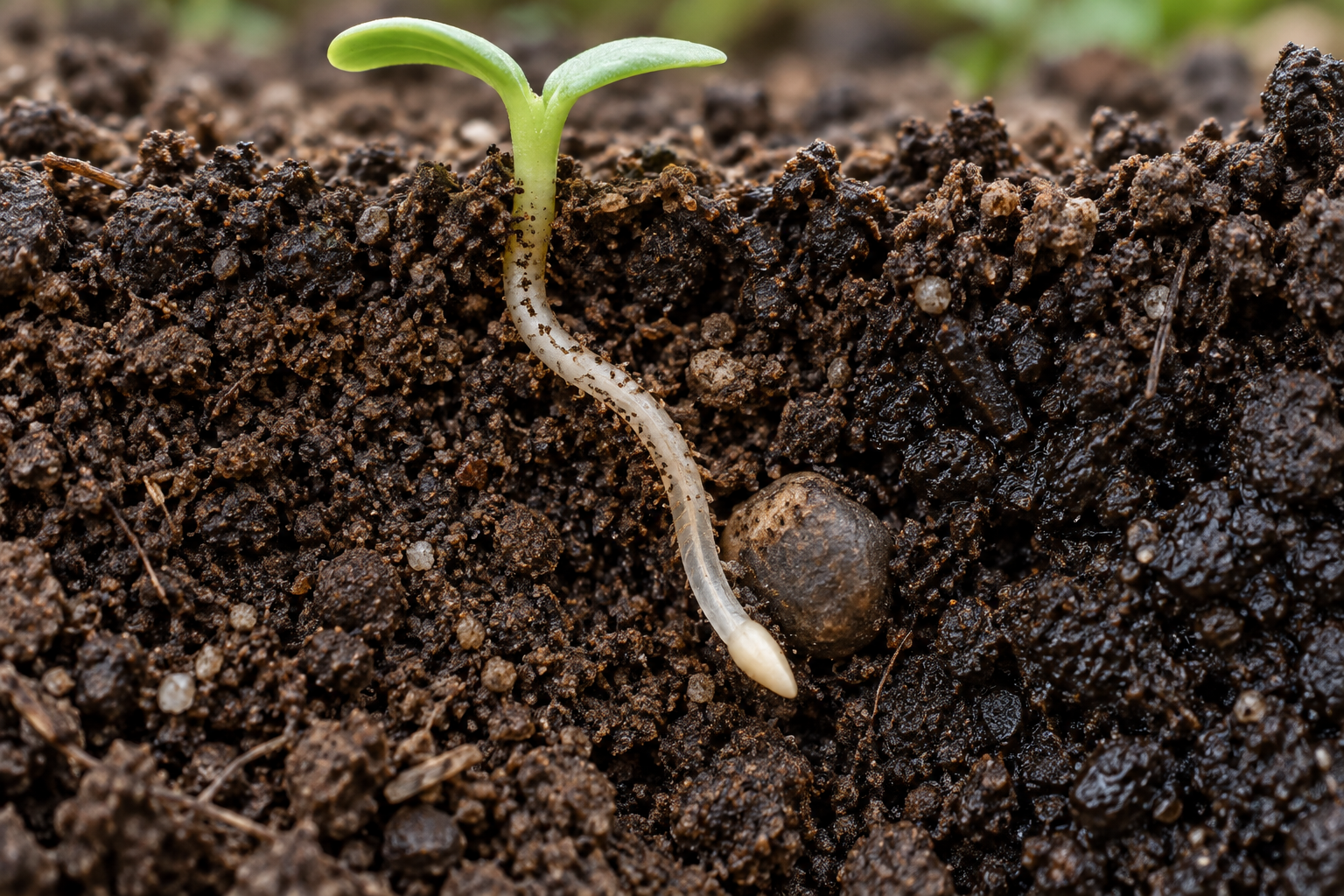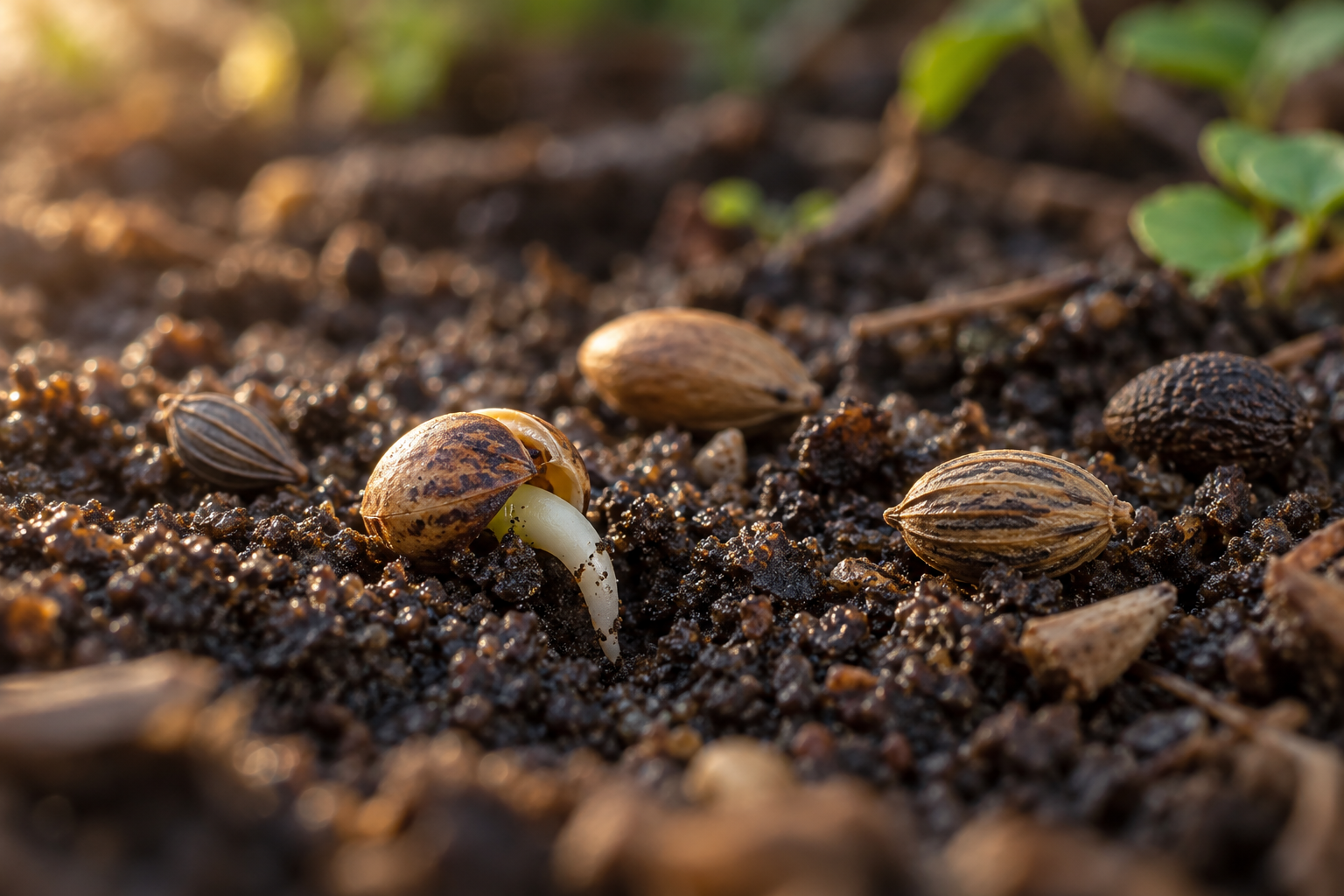
A seed that does not sprout on damp soil leaves a difficult question. Has it died, or is it waiting? The two possibilities look much the same from above. Inside an intact seed, though, the difference matters: a viable seed may have absorbed water and begun preparing its cells for growth while its root has still not emerged. Germination, in the strict botanical sense, ends when that root breaks through. Before then, silence at the soil surface tells us remarkably little.
The Millennium Seed Bank's germination guide calls a seed dormant when it fails to germinate under conditions that would otherwise be favourable. That definition has a trap. We must know what favourable means for the species, and whether the seed is alive, before giving its delay a name. Moisture alone is not a season. Temperature, light, oxygen and their changes over time may all matter.
More than one kind of lock
Some seeds cannot take in water until their coat becomes permeable. Others take in water but retain a physiological block on the embryo's growth. In still others, the embryo is underdeveloped at dispersal and must grow inside the seed before a root can appear. Kew's classification of dormancy separates these physical, physiological and morphological forms, and recognizes combinations of them. A seed coat can be a gate, an embryo can have its own brake, and both can operate in the same seed.
Big deervetch offers a concrete example. In its plant fact sheet, the US Department of Agriculture describes seed with both an impermeable coat and physiological dormancy. Its propagation protocol abrades the coat, then gives the moistened seed 60–90 days of cold treatment. The first step allows water in; the second addresses a different restraint. A single trick would not answer both. Those numbers belong to big deervetch and the specified seed lots, not to every wildflower packet.
The gates also explain why advice about “breaking dormancy” can be too blunt. Abrading a permeable seed coat will not supply a missing winter. Chilling seed that cannot take up water may leave the first barrier intact. Even within a species, populations can differ. Kew advises seed-bank workers to research the species and its collection climate before selecting a test, and to keep an untreated comparison when they try a dormancy treatment. The aim is to discover what the seed responds to, rather than make it endure every available intervention.
A season can change the seed
The wait is sometimes a way of reading a sequence of conditions, not simply a delay of a fixed length. Kew illustrates this with Persicaria maculosa collected in Slovakia. Autumn and spring can offer similar immediate temperatures, yet dormancy delays germination until spring; the species also needs a daily alternation between warmer and cooler temperatures in the guide's test. A favourable hour in autumn does not carry the same history as a favourable hour after winter.
The sequence can run through dry storage as well as cold, wet ground. In a 2019 sunflower experiment, freshly harvested dormant seeds failed to germinate at 10°C but germinated at 20°C. After a period of dry after-ripening, seeds from the study could also germinate at 10°C. The cooler test had not changed; the seeds' range of acceptable conditions had. That is a more exact picture of after-ripening than saying that time simply “wakes” a seed.
There is machinery beneath that change, but no universal switch. Plant hormones called abscisic acid and gibberellins are important in dormancy and germination. In the sunflower study, temperature and dry after-ripening both made germination possible, yet the measured hormone patterns were not identical. A 2023 study of Arabidopsis found that after-ripening was associated with more of one active gibberellin in seeds beginning to take up water. At an early measurement, abscisic acid had risen too, rather than obediently falling first. The authors propose that its later decline may be part of a final checkpoint, and note that later measurements are needed to test that model. “More growth hormone, less dormancy hormone” is a useful sketch, but it cannot stand in for the timing observed in a seed.
This matters because germination exposes a plant to a new set of risks. An ungerminated seed may remain in the soil through a dry spell or cold snap. A root that has pushed out needs a place to grow and water it can reach. Dormancy changes the conditions under which that start is taken. It cannot guarantee that the chosen moment will be safe.
What the seeds that stay behind can do
Waiting can also divide a cohort across years. In experiments with six winter annuals from near Portal, Arizona, Thomas Philippi followed seeds beyond their first opportunity to germinate. Some that stayed dormant under good conditions in year one germinated under the same conditions in later years. Their behaviour differed substantially by species and seed age. The result gives the familiar idea of spreading risk across seasons an observable mechanism: a failed year need not expose every seed at once.
The explanation has limits. A 2023 study of 20 populations of the winter annual Clarkia xantiana combined long-term demographic records with field germination experiments. Delayed germination increased long-term fitness in seven populations, but the researchers did not find consistent support for the bet-hedging pattern predicted across all twenty. Their model's optimal germination fractions were much higher than the fractions observed. The researchers conclude that complementary forces are needed to explain the observed delays. The seed bank is observable; its causes require more than one explanation.
For anyone trying to grow a plant, this uncertainty has a practical consequence. A tray with few seedlings is a result, not yet a diagnosis. It might contain dead seeds, viable dormant seeds, seeds given the wrong light or temperature, or a mixture. The Millennium Seed Bank's testing procedure records the conditions and dates, then examines seeds that did not germinate. A cut test distinguishes apparently fresh seeds from mouldy, empty or insect-damaged ones, though Kew cautions that the viability estimate from cutting is imperfect. The comparison between germination and estimated viability tells workers whether another test condition may be worth trying.
This is why the most useful question about an unsprouted seed is narrower than “How long should I wait?” Which species is it? What has the seed already experienced? Can water enter? Is the embryo ready? What would distinguish dormancy from death in this particular lot? Each answer removes one guess. The small, quiet object on the soil may be finished; it may also be keeping time by means the surface cannot show.
A thought worth keeping?